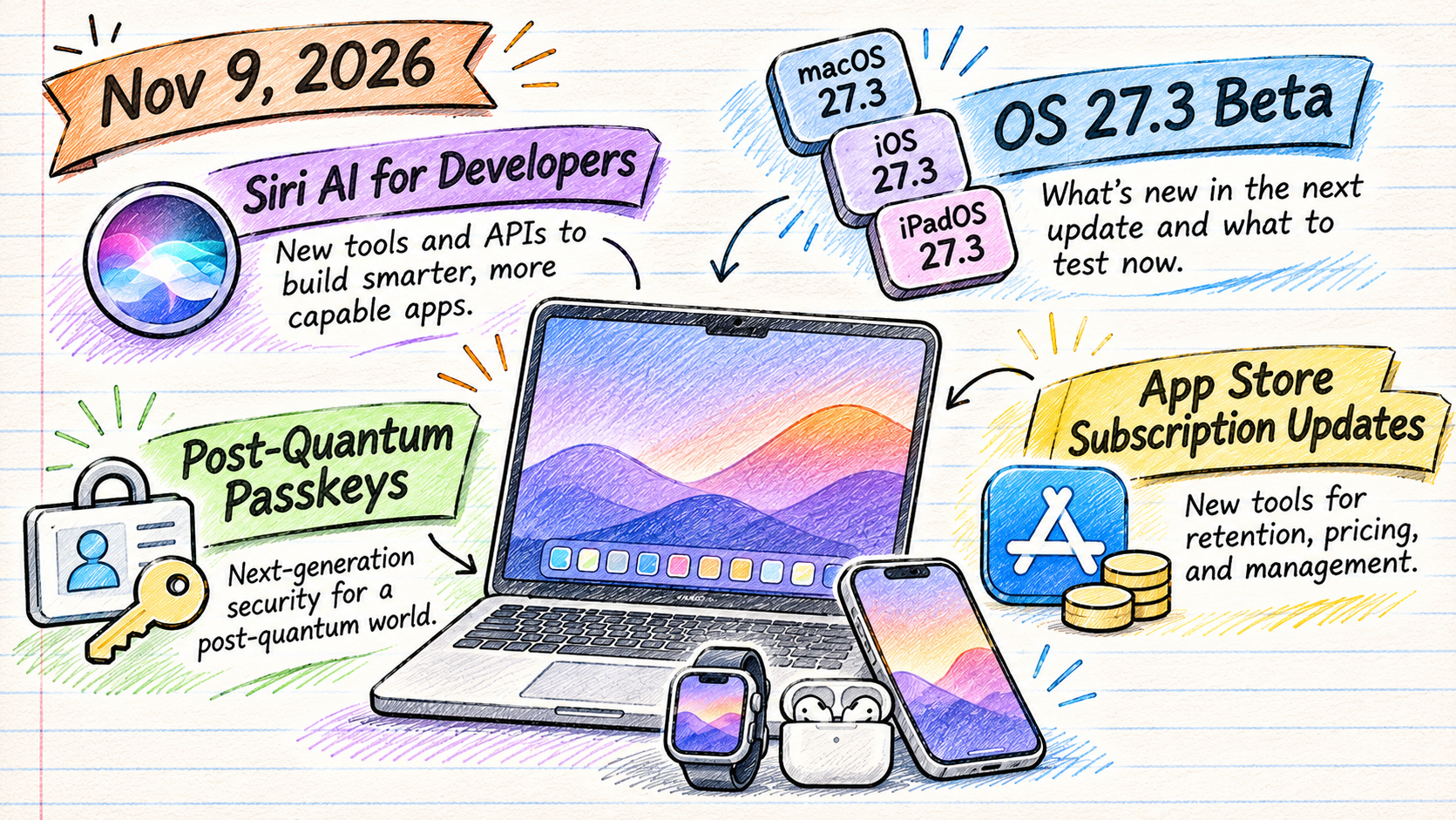
Apple IT Weekly: Siri AI Opens to Developers, OS 27.3 Enters Testing, and Passkeys Prepare for the Quantum Era
Week of November 9, 2026
This week, two developments caught my attention because they point toward a larger change in how we will manage security and software on Apple devices.
Apple has opened Siri AI integration to third-party developers, making the next generation of intelligent application automation available for testing. At the same time, 1Password has begun supporting post-quantum passkeys, introducing a new cryptographic foundation for authentication that could eventually affect nearly every identity system we manage.
Neither development requires an immediate overhaul of a client’s environment. Both deserve attention now.
Apple also released the first 27.3 betas across its operating systems on November 3, giving us another opportunity to validate the changes introduced in macOS 27.2 before the next production release.
What interests me most is the connection between these developments. Apple is making applications more capable of acting on behalf of users, while the security industry is preparing to strengthen the credentials those applications and users depend on.
For consultants, those two trends need to evolve together.
Siri AI Is Now Open to Third-Party Developers
On November 3, Apple announced that developers can begin integrating their applications with Siri AI through a new developer preview.
The capability is available for testing with iOS 27.3, iPadOS 27.3, macOS 27.3, and visionOS 27.3 betas.
This is more than another improvement to voice commands.
Apple is extending its conversational assistant into third-party applications, allowing developers to expose application functionality through a more intelligent, context-aware interface. Apple Developer
For an Apple consultant, the important question is not whether Siri can launch an application. We have had that capability for years.
The more interesting question is what happens when an assistant can interpret a user’s request, understand the context, and initiate actions inside business applications.
Consider a client who wants to locate a document, retrieve information from a business system, or complete a workflow involving several applications.
Those are exactly the kinds of activities where intelligent application integration could eventually reduce friction.
But they are also activities that involve permissions, sensitive information, and sometimes irreversible actions.
AI automation needs an authorization strategy
I would approach Siri AI integration much as I would any other automation platform with access to business information.
The application should remain responsible for enforcing authorization. An assistant understanding a request does not mean the user is authorized to perform the requested operation.
For developers building integrations, I would pay attention to three things: which application functions are exposed, what information those functions can access, and which operations require explicit user confirmation.
For managed environments, I would also evaluate whether existing restrictions, application authentication, and data-protection policies continue to work as intended.
Apple’s announcement is a developer preview, not a reason to assume that every existing application will suddenly become controllable through Siri.
The availability of individual integrations will depend on developers implementing them, and Apple notes that Siri AI features vary by region and language. Apple also says the service is currently unavailable in the European Union on iOS and iPadOS. Apple Developer
For my clients, this is worth testing, particularly where custom business applications or sensitive information are involved.
Official source: Apple Developer News — November 3, 2026.
OS 27.3 Begins Its Beta Cycle
Apple released the first developer betas of its 27.3 operating-system updates on November 3.
NEW DEVELOPER BETAS · NOVEMBER 3
| macOS 27.3 | 26C5035r |
| iOS / iPadOS 27.3 | 24C5037i |
| watchOS 27.3 | 24S5284h |
| tvOS 27.3 | 24K5286g |
| visionOS 27.3 | 24N5286r |
| Xcode 27.3 beta | 27C5020n |
Source: Apple Developer Releases.
Last week’s article focused on macOS 27.2, particularly the Platform SSO fixes, remote-support improvements, and security updates.
Those remain the production issues I would prioritize.
The new 27.3 betas are a separate testing opportunity.
I would use a representative managed Mac to verify Automated Device Enrollment, Platform SSO, FileVault, Bootstrap Token, declarative software updates, VPN, network extensions, and endpoint-security software.
I would also include the applications that depend on privacy permissions, especially backup and remote-support tools.
Apple’s previously announced changes to Full Disk Access remain an important consideration, but I did not verify a new production restriction this week. I would not redesign working PPPC profiles based on speculation about how those future controls might be implemented.
The key is to distinguish between testing an upcoming operating system and approving it for production.
For most clients, 27.3 belongs in the lab for now.
Post-Quantum Passkeys: Why 1Password’s Announcement Matters
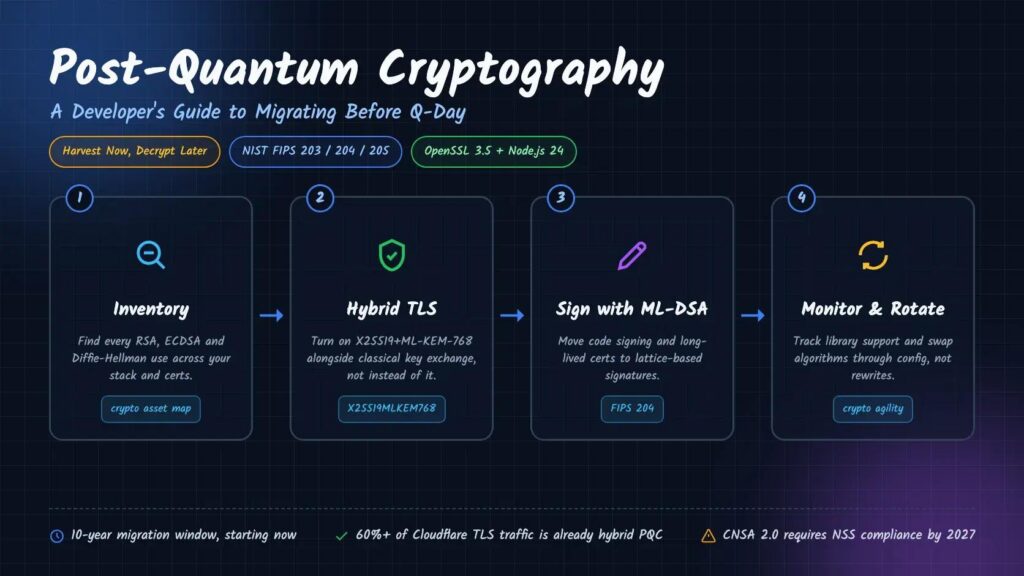
One of the most interesting security developments I reviewed this week was 1Password’s October 20 article, Launching post-quantum safe passkeys.
Although the announcement predates this week’s reporting period, I wanted to examine it because the implications extend well beyond password managers.
Starting with version 8.12.44, 1Password supports passkeys using ML-DSA, a post-quantum digital-signature algorithm.
This is an important step toward preparing passkey authentication for a future in which sufficiently capable quantum computers could undermine the public-key algorithms commonly used today. 1Password
Why today’s passkeys need to evolve
Traditional passkeys are built around public-key cryptography.
When a user registers a passkey, the authenticator creates a private key and a corresponding public key.
The private key remains under the authenticator’s control. The website stores the public key and uses it to verify signatures during authentication.
This is a substantial security improvement over passwords because there is no reusable password secret stored by the website that can simply be stolen and replayed.
Passkeys also provide strong phishing resistance through their binding to the legitimate website.
But many existing passkeys use elliptic-curve cryptography.
A sufficiently powerful quantum computer running Shor’s algorithm could threaten the mathematical assumptions underlying those signatures.
That does not mean today’s passkeys are suddenly unsafe.
There is no publicly demonstrated cryptographically relevant quantum computer capable of breaking the widely deployed algorithms at the scale required.
The concern is that passkeys may remain in use for many years, potentially long enough for the threat environment to change.
What ML-DSA changes
ML-DSA stands for Module-Lattice-Based Digital Signature Algorithm.
Rather than relying on the mathematical problems used by traditional elliptic-curve signatures, ML-DSA uses lattice-based cryptography designed to resist known quantum attacks.
The National Institute of Standards and Technology standardized ML-DSA in August 2024 as FIPS 204.
The IETF subsequently published RFC 9964 in May 2026, defining how ML-DSA signatures and keys can be represented in JOSE and COSE formats.
That COSE support is particularly relevant because WebAuthn and FIDO authentication protocols use COSE algorithm identifiers and key representations. csrc.nist.gov+1
In practical terms, the standards work is creating a path for passkey authenticators and websites to support quantum-resistant signatures.
But standards availability is not the same as universal interoperability.
Both the authenticator and the relying website must support the relevant algorithm.
What 1Password actually supports today
1Password’s implementation is an early adoption of ML-DSA passkeys.
It does not mean that all existing 1Password passkeys have been converted, nor that every new passkey automatically uses ML-DSA.
The website must support the algorithm before 1Password can create that kind of credential.
There are also platform limitations.
According to 1Password, ML-DSA passkey authentication works across supported platforms, but creating an ML-DSA passkey is not yet supported on iOS or through the native macOS autofill extension. 1Password
That distinction is particularly important for Apple consultants.
I would not describe Apple’s built-in Passwords app or iCloud Keychain passkeys as post-quantum simply because 1Password now supports ML-DSA.
The credential provider, operating-system integration, browser, and website each have a role in the authentication process.
Apple has not established through the sources I reviewed that its built-in passkey provider now generates ML-DSA credentials.
For now, this is an emerging capability to evaluate rather than an organization-wide migration to initiate.
What I Would Test on Apple Devices
If a client uses 1Password for business credential management, I would start with a small compatibility test.
1Password recommends using webauthn.io, where the advanced registration settings allow an ML-DSA variant to be selected.
I would test registration and authentication in a supported desktop browser, then compare the behavior with Safari, native macOS autofill, and iOS.
I would record the actual credential algorithm rather than assume that successful passkey authentication means ML-DSA was used.
I would also test what happens when a user switches devices, uses a different browser, or attempts to recover access.
The most important thing is not to disrupt working authentication.
Existing passkeys remain a strong security choice today. Organizations should continue adopting phishing-resistant authentication rather than postponing deployment until post-quantum support is universal.
For my clients, the immediate recommendation would be to monitor compatibility and inventory dependencies, not replace every passkey.
Post-Quantum Passkeys Are Only One Part of the Security Transition
There is another distinction worth making.
Post-quantum digital signatures and post-quantum key exchange solve different problems.
ML-DSA is intended for signatures and authentication.
ML-KEM, another NIST-standardized algorithm, addresses key establishment.
Earlier in 2026, 1Password introduced hybrid post-quantum key exchange for its web application connections, combining classical X25519 with ML-KEM.
That helps protect encrypted connections against future cryptographic attacks, including the concern that encrypted traffic captured today could be decrypted later if vulnerable key-exchange methods are broken.
The new ML-DSA passkey support addresses a different part of the security architecture: authentication signatures. 1Password
For consultants, I would begin treating post-quantum readiness as a broader inventory exercise.
Which services use TLS? Which identity providers issue passkeys? Which applications rely on certificates? Which systems use long-lived cryptographic signatures?
Those are the questions that will eventually matter more than whether a single password manager supports a particular algorithm.
Subscription Management Gets Another Developer Feature
Apple also announced a new App Store subscription feature on November 4: retention messages.
Developers can configure messages that appear when a subscriber begins canceling an auto-renewable subscription.
Those messages can include text, images, or special offers. Apple also provides a Retention Messaging API, available by request, that lets developers select messages based on subscription details. Apple Developer
For most MSPs, this is not a device-management change.
It is, however, relevant to consultants who develop and distribute applications.
I would distinguish this announcement from the organizational subscription Volume Purchasing feature introduced in October.
Volume Purchasing concerns how organizations acquire and assign eligible subscriptions.
Retention messages concern how developers communicate with customers during cancellation.
They operate at different points in the subscription lifecycle.
For anyone publishing commercial applications, retention messages may be worth testing. For organizations managing employee application licenses, the more important task remains validating subscription assignment and recovery through Apple Business and the MDM platform.
What This Means for Client Environments
The changes this week reinforce several priorities I already consider important in Apple consulting.
For organizations using Microsoft Entra ID and Platform SSO, I would continue validating macOS 27.2 in production while preparing a separate 27.3 test environment.
For clients using 1Password, I would document the new ML-DSA capability and begin evaluating browser and credential-provider compatibility without forcing credential replacement.
For clients developing internal applications, I would investigate Siri AI integration carefully, especially where the application can access confidential data or perform business transactions.
And for clients using Apple Business, I would continue the subscription licensing work from the previous briefing rather than treating last month’s announcement as a new development.
I did not verify a material new change this week to Apple Business federation, Managed Apple Accounts, Automated Device Enrollment, Activation Lock, Secure Token, recovery-key escrow, or the core DDM management framework.
That is worth saying because not every weekly briefing needs a new management-framework headline.
Sometimes the most valuable work is validating the changes already in progress.
The Bigger Story
The larger pattern I see is that Apple devices are becoming platforms for increasingly capable automation, while the identity systems surrounding those devices are undergoing their own security transition.
Siri AI represents one direction: applications becoming easier to control through natural language and intelligent assistants.
Post-quantum passkeys represent another: the authentication mechanisms behind those applications evolving to withstand future cryptographic threats.
These developments are not directly dependent on one another, but they belong in the same long-term security discussion.
As software becomes more capable of acting on behalf of users, it becomes even more important to know who is authenticated, what that user is authorized to do, and how those permissions are enforced.
That is why I would approach AI integration and modern authentication as complementary areas of consulting expertise.
The Bottom Line
This week’s most important new Apple development is the opening of Siri AI to third-party developers, alongside the arrival of the OS 27.3 beta cycle.
The most interesting longer-term security development is 1Password’s support for post-quantum ML-DSA passkeys.
I would test Siri AI integrations in controlled environments, continue validating the production OS 27.2 security and identity fixes, and begin learning how post-quantum authentication will fit into the Apple ecosystem.
There is no need to rush clients into replacing their existing passkeys or deploying beta operating systems.
But there is every reason to start preparing.
The next generation of Apple IT will require us to understand not just how devices are managed, but how intelligent applications act, how identities are verified, and how security holds up as the underlying technology changes.